Early access. I’m trying Rental Bill Tracker with a small group of landlords before it launches. Download the free trial, use it on your real bills, and email me what works and what doesn’t.

Tax season shouldn’t start
with a shoebox of bills.

A simple Windows app for small landlords. Snap a bill on your phone and it seamlessly transfers to your PC, or drop in PDFs — it reads them, files them by LLC and property, tells you what’s due or missing, and builds the Schedule E report for your accountant.

Windows 10 and 11 · Free for 30 days, then pay once — no subscription · Your data stays on your PC

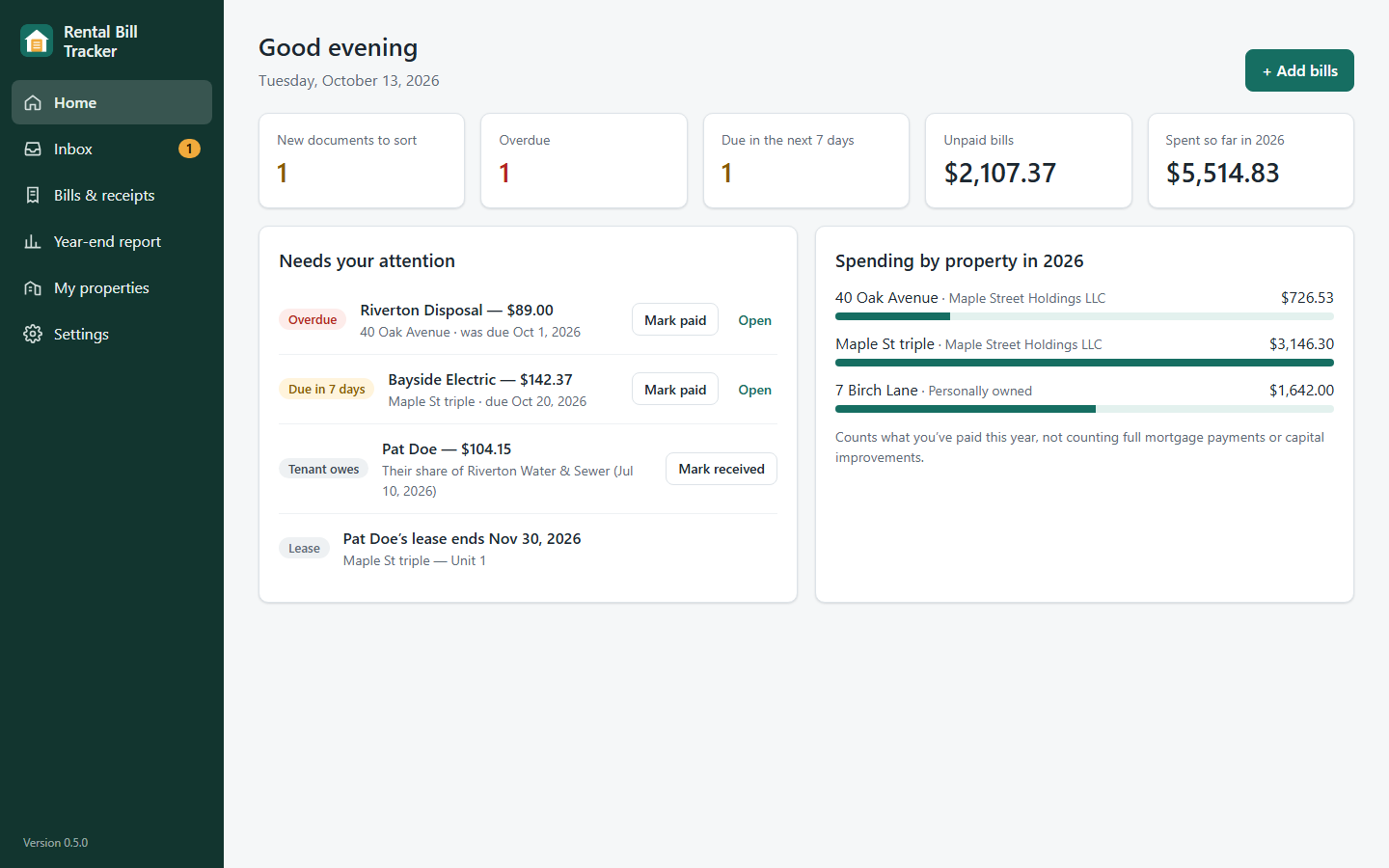
The Rental Bill Tracker home screen: bills overdue and due this week, a tenant's share of a water bill to collect, a lease ending, and spending by property this year.

New · From your phone

Snap a bill on your phone. It seamlessly transfers to your PC.

Most bills still come on paper. Take a photo of it, and seconds later it’s in the Inbox on your computer — already read and matched to the right property. No cables, no emailing yourself, no app to install.

  1. 1

    Scan the QR code, once

    The app shows a code on your computer. Point your phone’s camera at it and add the page to your home screen.

  2. 2

    Snap the bill

    Tap Take a photo of a bill. For the sharpest read, use your phone’s own document scanner — in Files or Notes on iPhone, Google Drive on Android.

  3. 3

    It’s on your PC

    The bill seamlessly transfers to the app’s Inbox, read and ready for you to check and file.

Works with iPhone and Android over your home Wi-Fi. Bills go straight from your phone to your computer — never through the internet or our servers. Prefer OneDrive? The app can watch a OneDrive folder instead.

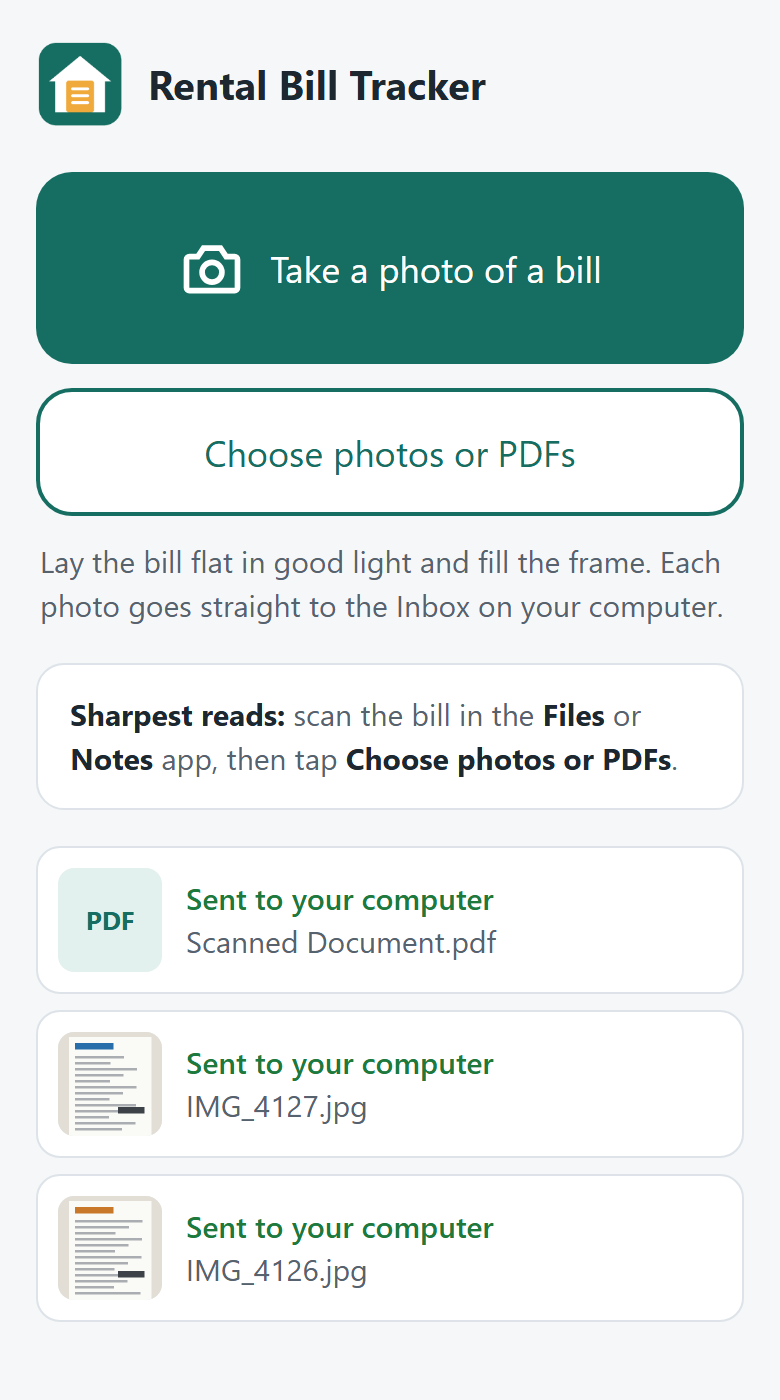
The Rental Bill Tracker page on a phone: a big Take a photo of a bill button, Choose photos or PDFs, and three bills marked Sent to your computer.

Up and running in an afternoon

No spreadsheets to design and nothing to learn. If you can drag a file, you can use it.

1

Tell it about your properties

A step-by-step setup asks for your LLCs, buildings, units and tenants, and the bills you get every month — about ten minutes.

2

Snap or drop in your bills

Photos from your phone seamlessly transfer to your PC. Or drag PDFs onto the window, or point your scanner at the app’s drop folder. It reads each one and suggests where it belongs.

3

Stay on top of it

Reminders before bills are due, a warning when a regular bill doesn’t arrive, and a report for your accountant at tax time.

It reads the bill for you

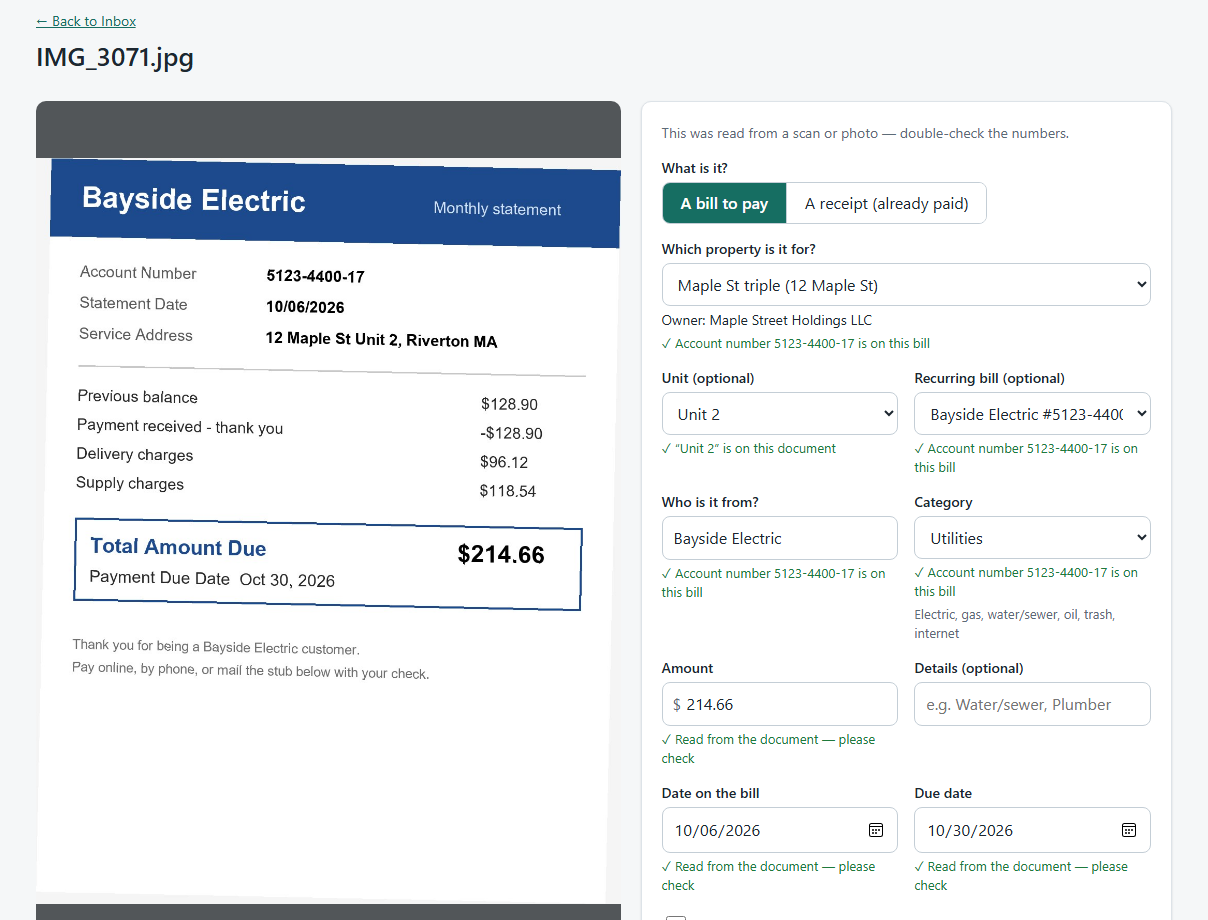
Open a bill and the form is already filled in: who it’s from, the amount, the bill and due dates, which property and unit — and a note saying why it thinks so, like “Account number 5123-4400-17 is on this bill”.

  • Works with PDFs from your utilities and with photos and phone scans of paper bills and receipts
  • Learns your vendors as you file, so the next one is quicker
  • Understands mortgage statements, tax bills and store receipts
  • You check it and click File it — nothing is filed without you seeing it
Reviewing a photographed electric bill: the property, unit, account, vendor, category, amount and dates are filled in, each with the reason for the guess.

Everything filed, and easy to find

Every bill and receipt is saved in ordinary folders on your computer — Rental Bills\Your LLC\12 Maple St\2026\Utilities — named by date, vendor and amount. You can find any document even without the app.

  • Search and filter by year, owner, property, category or paid status
  • Mark bills paid as you pay them
  • Pass part of a bill on to a tenant, like their share of the water bill, and track what they owe
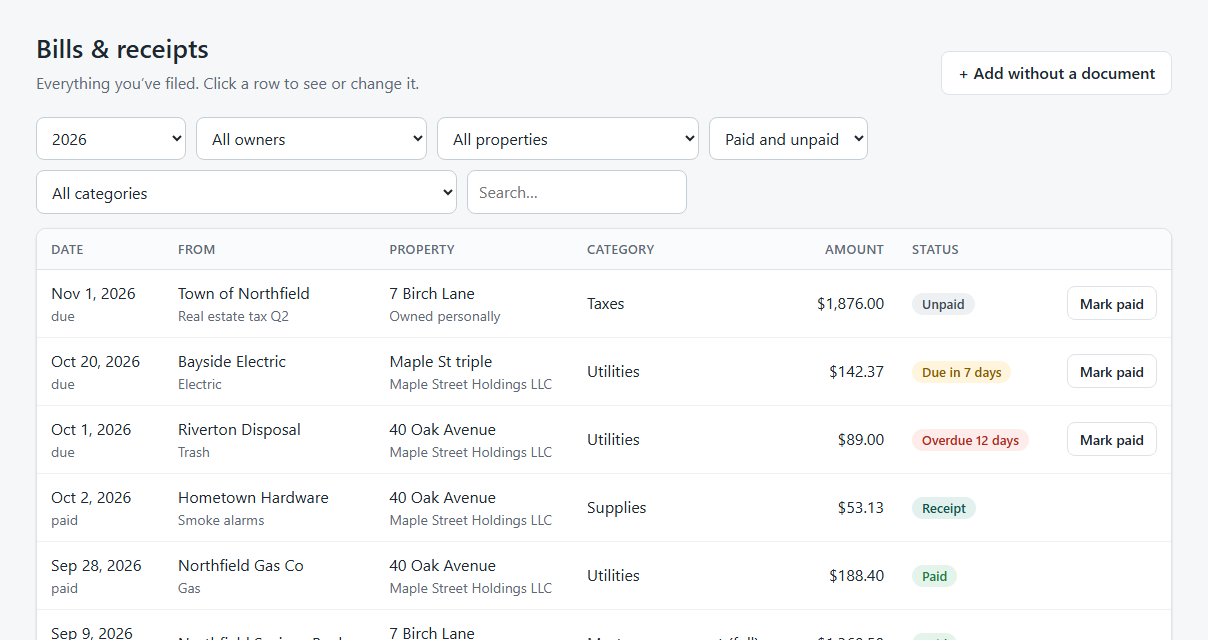
The list of bills and receipts with dates, vendors, properties and owners, categories, amounts and paid status.

Tax time in one click

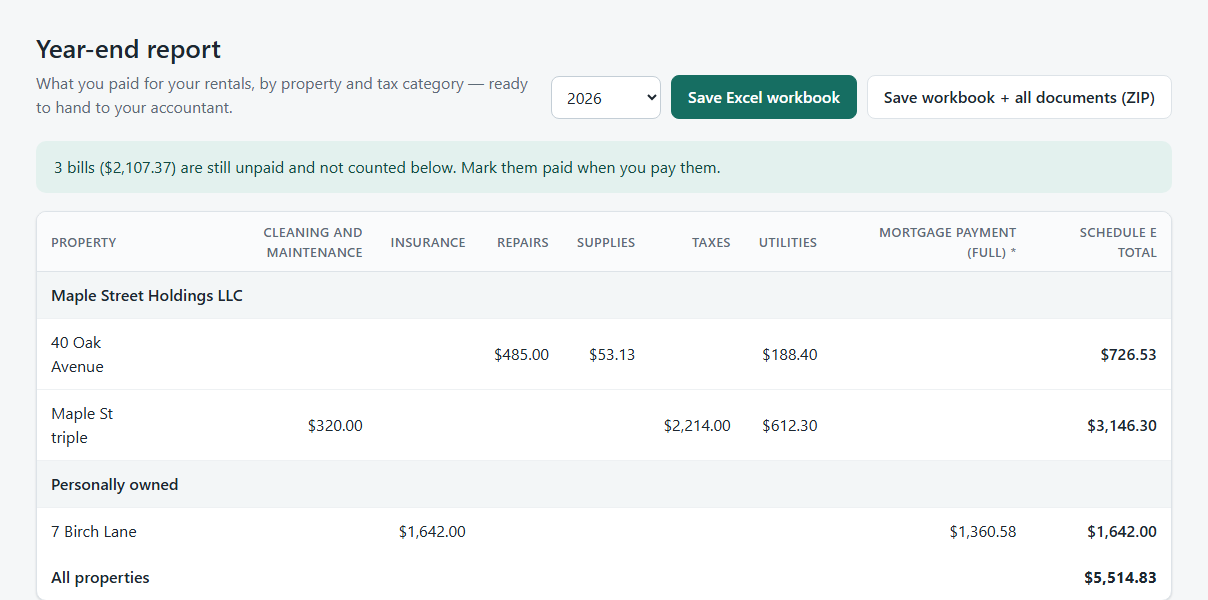
The year-end report totals what you paid for each property, under the same expense lines as IRS Schedule E. Save it as an Excel workbook — with a link to every document — or as a single ZIP with all the year’s bills, ready to hand to your accountant.

  • Counted in the year you paid, the way most small landlords file
  • Mortgage payments and capital improvements kept separate, so they aren’t added in by mistake
  • Grouped by LLC when you own through more than one
The year-end report: expenses by property under Schedule E categories, grouped by LLC, with buttons to save an Excel workbook or a ZIP of all documents.

Built for how landlords really own

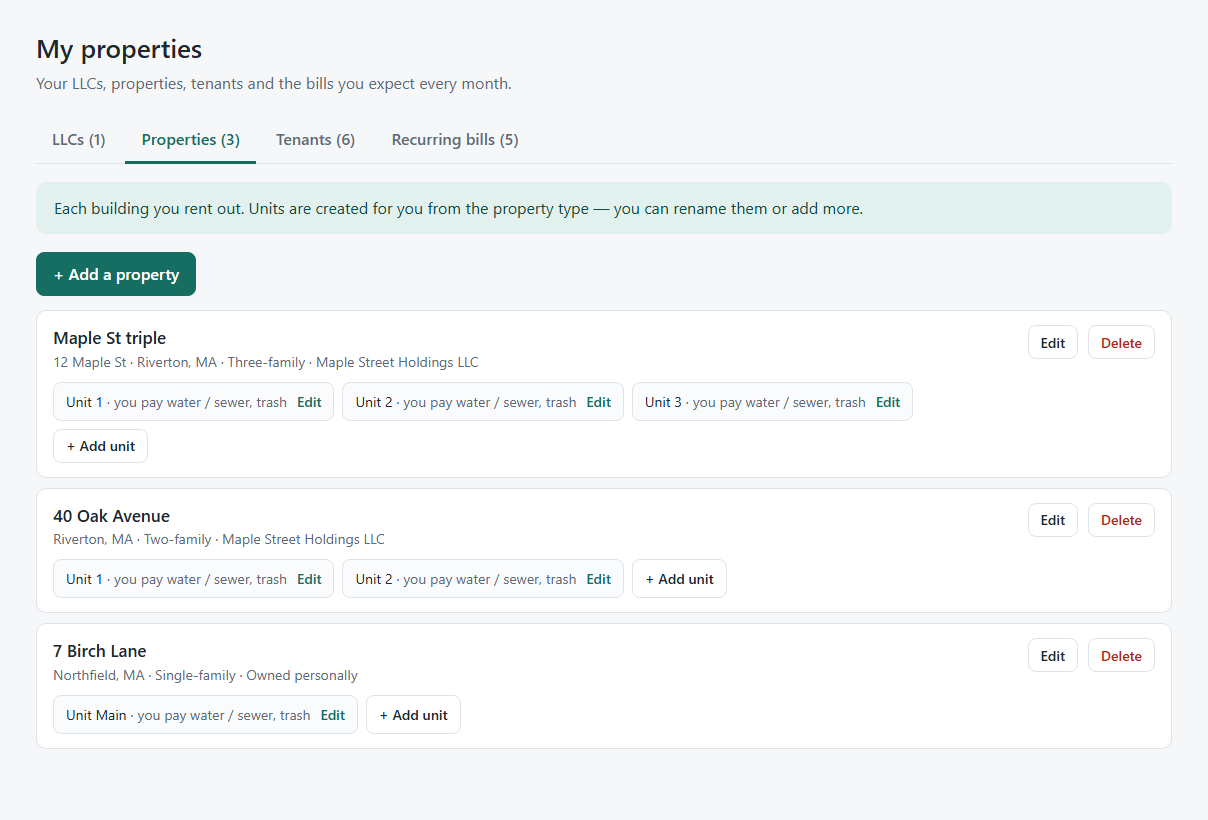
Own one building in your own name and two through an LLC? Set it up that way. Every bill shows which LLC it belongs to, and the folders and reports follow.

  • Several LLCs, or none at all
  • Single-family homes to multi-families, with units and tenants
  • Move a property into an LLC later, and its bills move with it
The properties list, each with its owner and units.

The small things that save you

Reminders

A reminder by the clock before bills are due, even with the window closed.

Notices missing bills

Did that electric bill ever arrive? If a bill you get every month or quarter doesn’t show up, it tells you — before it becomes a late fee.

Automatic backups

A daily backup to your OneDrive or Dropbox folder, with one-click restore.

Private by design

No online account. Your bills and records stay on your own computer and work without internet.

Leases at a glance

See which leases end in the next two months, right on the home screen.

Smarter reading, optional

Messy bills? Turn on reading with Claude, an AI from Anthropic, using your own key. Off unless you choose it.

Simple pricing

Try everything free for 30 days. Then one license for each computer you use it on.

Founder price
$89 per computer

Pay once. No subscription.

  • Every feature — no tiers, no add-ons
  • Unlimited properties, units, tenants and bills
  • Your data on your computer, never locked away
  • Help by email from the landlord who built it
Start the free trial

1. Try it free

Install and use every feature for 30 days. No card, no sign-up.

2. Send us your computer code

When you’re ready, the app shows a short code for your computer. Email it to us.

3. Paste your key

We send back your license key. Paste it in and you’re set — no account, no subscription, nothing to renew.

Questions

What happens after the 30-day trial?

The app becomes read-only until it’s activated. Nothing is deleted: you can still open, search and export everything, run the year-end report and make backups. Activating with a license key unlocks adding and changing bills again.

Is it a subscription?

No. You pay once for each computer you use it on, and the license doesn’t expire. Try it free for 30 days first.

Where is my information kept?

On your own computer. Bills and receipts are saved in a “Rental Bills” folder in your Documents, and the app’s records in your Windows user folder. Nothing is uploaded anywhere — the only exception is the optional Claude reading, which you turn on yourself.

Do I need to be online?

No. It reads bills, sends reminders and makes reports without internet. Your daily backup goes to whatever folder you choose — a OneDrive or Dropbox folder keeps a copy off the computer.

Does it work on a Mac?

Not yet — it runs on Windows 10 and Windows 11.

I’m getting a new computer. Do I have to buy again?

No. On the old computer, open Settings → License → Move to a new computer. It gives you a release code; email it with the new computer’s code and you’ll get a key for the new one, free. Make a backup first to bring your bills along. Old computer broken or lost? Just email us.

Windows says “Windows protected your PC” when I run the installer.

Windows shows that for new programs it hasn’t seen many times yet. Click More info, then Run anyway. Stuck? Email rentalbilltracker@gmail.com and we’ll walk you through it.

Will it do my taxes?

No — it keeps your expenses organized and totals them under the Schedule E lines so your accountant (or your tax software) has everything in one place. It isn’t tax advice.

Can it read every bill?

It reads PDFs from utilities, insurers and towns very well, and photos of paper bills and receipts using the text recognition built into Windows. Scanning with your phone’s document scanner (Files or Notes on iPhone, Google Drive on Android) gives the sharpest read. It always shows you what it read so you can correct anything before filing.

How do bills get from my phone to my computer?

Over your home Wi-Fi. In the app, open Settings → Send bills from your phone and scan the QR code with your phone’s camera — no app to download. Then take a photo, or pick a scan, and it seamlessly transfers to the Inbox on your computer. Your phone and computer need to be on the same Wi-Fi, with the app running (it can sit in the tray). Computer asleep or off? Your photos wait safely on the phone and send themselves once it’s back.

Do my bill photos go through the internet?

No. They go directly from your phone to your computer over your own Wi-Fi, through a private link only your phone has. They never pass through our servers or anyone else’s. If you’d rather use OneDrive, the app can watch a OneDrive folder that your phone saves to.
Built by a landlord. Write to him directly.

Rental Bill Tracker was built by Khac Thai, a Massachusetts landlord with his own pile of bills. Questions before you buy, help getting set up, or your license key — email him directly.

Trying it early? Your feedback shapes what comes next. Anything confusing, a bill it read wrong, a feature you missed — send it over.